
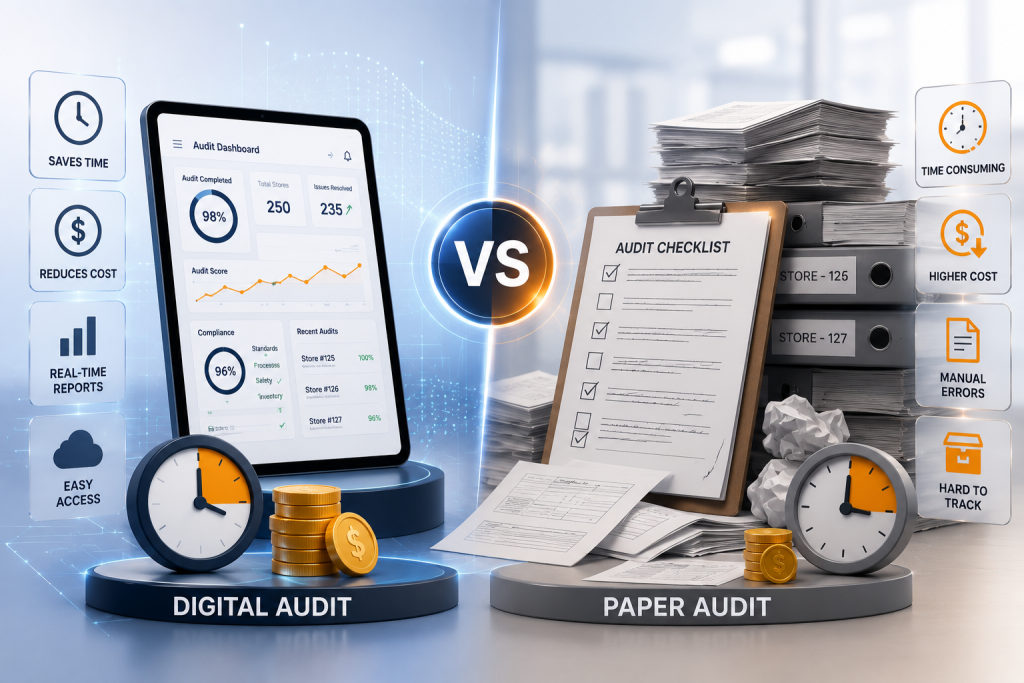
Digital Audit vs Paper Audit: Which Saves More Time & Money?
As businesses expand across multiple locations, managing audits efficiently becomes more challenging. Whether you operate retail stores, restaurants, warehouses, or franchise outlets, regular audits help maintain compliance, improve operational performance, and deliver a consistent customer experience.
For years, businesses relied on paper-based checklists to conduct inspections. While this method is familiar, it often results in manual errors, delayed reporting, and higher administrative costs. Today, many organizations are switching to digital audit software to simplify inspections and gain real-time visibility into their operations.
In this guide, we’ll compare Digital Audit vs Paper Audit and explore why digital audits are becoming the preferred choice for modern businesses.
What is a Paper Audit?
A paper audit is the traditional method of conducting inspections using printed forms or handwritten checklists. Auditors record observations manually and submit reports for review after completing the inspection.
Although paper audits can work for small businesses, they become difficult to manage as operations grow. Managing physical records, preparing reports, and tracking corrective actions often takes more time and increases the risk of errors.
Common Challenges of Paper Audits
- Manual data entry
- Delayed report preparation
- Lost or damaged documents
- Human errors
- Difficult record management
- Limited visibility across multiple locations
What is a Digital Audit?
A digital audit replaces paper forms with mobile or cloud-based audit software. Auditors can complete inspections using smartphones or tablets, attach photos, and submit reports instantly.
Managers receive real-time updates, making it easier to monitor compliance, identify issues, and take corrective action without delays.
Digital Audit vs Paper Audit: Comparison
| Feature | Digital Audit | Paper Audit |
| Audit Completion | Fast & Paperless | Manual Process |
| Report Generation | Instant | Time-Consuming |
| Data Accuracy | High | Prone to Errors |
| Corrective Actions | Instant Assignment | Manual Follow-up |
| Record Storage | Cloud-Based | Physical Files |
| Multi-Location Monitoring | Centralized Dashboard | Separate Records |
| Operational Cost | Lower | Higher |
Why Digital Audits Save More Time
Digital audits eliminate repetitive manual work and make inspections much more efficient.
Businesses save time by:
- Completing audits on mobile devices
- Generating reports automatically
- Sharing results instantly
- Tracking corrective actions in real time
- Accessing audit records from one centralized platform
Instead of waiting hours or even days for reports, managers receive actionable insights immediately after an inspection is completed.
Why Digital Audits Save More Money
Switching to digital audits doesn’t just improve efficiency—it also helps reduce operational costs.
Businesses can lower expenses by:
- Eliminating printing and paper costs
- Reducing manual administrative work
- Minimizing reporting errors
- Improving employee productivity
- Preventing compliance-related issues
As audit volumes increase, these savings become even more significant.
Why Businesses Are Switching to Digital Audits
Modern businesses need faster reporting, better visibility, and standardized processes across every location.
Digital audit software helps organizations:
- Standardize audit checklists
- Improve compliance
- Monitor multiple locations from one dashboard
- Store audit records securely
- Generate real-time reports
- Improve accountability across teams
These advantages enable businesses to make faster decisions while maintaining consistent operational standards.
How DoAudits Helps
DoAudits simplifies the entire audit process by replacing paper-based inspections with smart digital workflows.
With DoAudits, businesses can:
- Create customized digital audit checklists
- Conduct inspections using mobile devices
- Capture photos during audits
- Assign corrective actions instantly
- Monitor multiple locations from a centralized dashboard
- Generate real-time reports and analytics
Whether you manage retail stores, restaurants, supermarkets, warehouses, or franchise networks, DoAudits helps improve compliance, increase efficiency, and simplify audit management.
Conclusion
When comparing Digital Audit vs Paper Audit, the benefits of digital audits are clear. While paper-based inspections rely on manual processes that consume time and increase costs, digital audits provide faster inspections, automated reporting, improved accuracy, and better operational visibility.
For businesses managing multiple locations, adopting digital audit software is a smart investment that improves efficiency, reduces costs, and supports better decision-making.
Ready to Go Paperless?
Transform the way you manage inspections with DoAudits. Create digital checklists, automate reporting, track corrective actions, and monitor every location from one powerful platform.
Book a free demo today and discover how DoAudits can help you save time, reduce costs, and improve compliance.
Frequently Asked Questions
1. What is the main difference between a digital audit and a paper audit?
A digital audit uses software or a mobile app to conduct inspections and generate reports instantly, while a paper audit relies on printed forms and manual documentation.
2. Why is digital audit software better for multi-location businesses?
It centralizes audit data, standardizes inspections, provides real-time reporting, and allows managers to monitor every location from a single dashboard.
3. Can digital audits improve compliance?
Yes. Digital audits help businesses maintain consistent inspection processes, track corrective actions, and securely store audit records for future reference.
4. Which industries benefit from digital audits?
Retail, hospitality, healthcare, manufacturing, logistics, facility management, restaurants, supermarkets, and franchise businesses all benefit from digital audit software.
5. How does DoAudits simplify audit management?
DoAudits enables businesses to digitize inspections, automate reporting, assign corrective actions, and monitor compliance across multiple locations through one centralized platform.